Laws & regulations
2 min. read
·11 December, 2023
·8 min. read
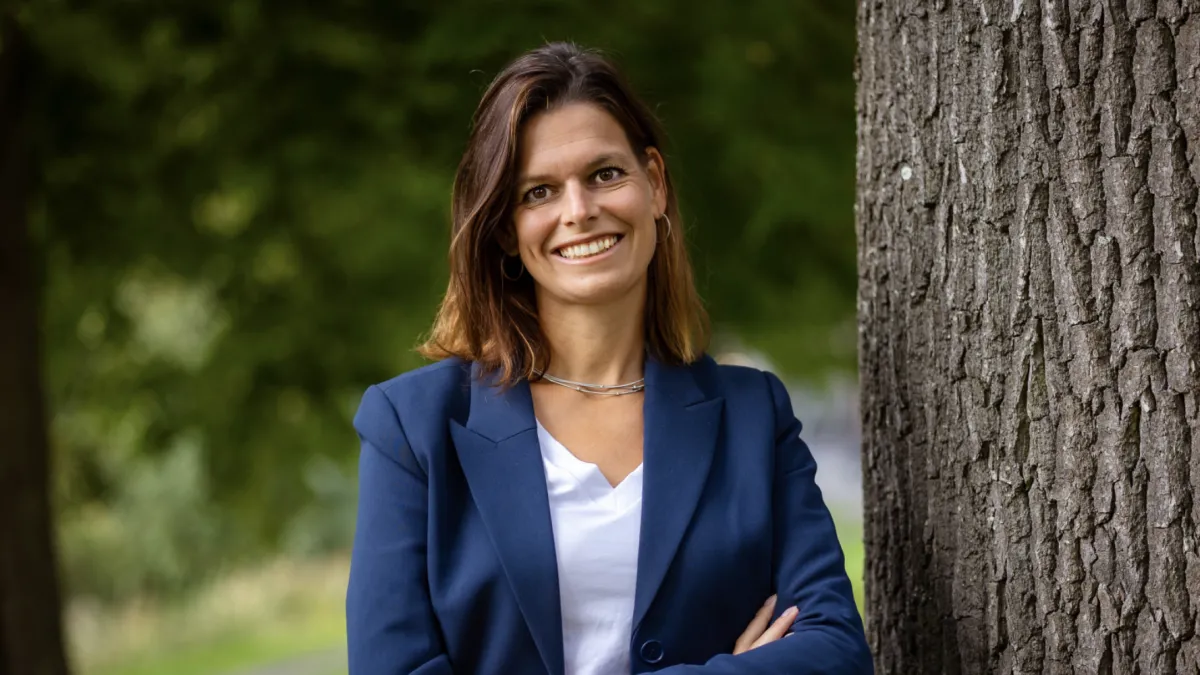
An article about Verena Jongepier in Zeeland Magazine 23 by Nelleke Launspach.
Sustainability: it is a term that is all the rage, but it also sometimes sparks skepticism - are companies really as “green” as they claim to be? With her platform, ecommit, Verena Jongepier not only makes it easy for companies to do business in a truly sustainable way, but she also ensures that this becomes visible and tangible. And that makes everyone happy, including Verena herself.
Verena Jongepier worked as a lawyer for many years, but two years ago she decided it was time for a new challenge. She wanted to focus on a different way to make the world a little better, so she embarked on a path of social entrepreneurship. She does this through her company, ecommit, which was founded to make it easier for small and medium-sized businesses to offset their carbon emissions.
“What you notice is that there is a strong push to cut back,” Verena begins. “Drive less, eat less meat, fly less, and so on. On the one hand, that is justified, because the world will not get any better if we keep going this way, but you notice that people find it hard to give something up and so are not exactly lining up to take a step back.
We believe we can accelerate the carbon reduction process by countering it with something positive. Reducing emissions is absolutely essential, but we can also do a little more to offset them - for example, by ensuring that more forests are planted. More forests mean more trees, and more trees mean that more carbon is removed from the air. We will also try to accelerate that carbon reduction through other projects. We are taking a positive approach rather than a negative one. Instead of saying what we cannot do, we are showing what we can do."
How exactly does that work? Ecommit invests in sustainable projects by purchasing carbon credits. They “split” these credits into smaller units, making it possible to offset carbon emissions for as little as a few kilograms or even for a one-time event. But a few metric tons is also possible, of course. Through their platform, as an SME, you can easily purchase a (flexible) package and determine the scope yourself or select a project. They currently collaborate with three types of projects: technology (to remove carbon from the air), agriculture (planting specific crops or implementing regenerative farming methods), and reforestation.
“The average business owner is willing to do something,” Verena explains, “but often does not know what or how. Moreover, reducing your carbon emissions is usually a multi-year plan. We show them: in addition to everything you are already doing, you can remove the remaining emissions from the atmosphere today. Our carbon credit serves as proof of authenticity to establish some order and rules regarding offsetting. In the past, things often went wrong in this area. For example, a forest planted to offset carbon emissions could be claimed by multiple people. We focus on busy entrepreneurs who do not have the time to delve into this themselves or free up staff to handle it. We thoroughly verify whether the projects are reliable, whether all the paperwork is in order, and whether the trees are actually there.”
There are now twenty people working at ecommit. Some of them visit business owners to explain how they can help them take a positive step forward. Other colleagues are working to spread the message digitally: through marketing, social media, newsletters, and, last but not least, their website, which features informative blogs and whitepapers. These cover not only their projects but also the laws and regulations that business owners must navigate when it comes to sustainability. Finally, carbon credits can actually be purchased online. “We are building a digital platform,” says Verena.
Ecommit currently focuses on various sectors of the SME market: construction, e-commerce, healthcare, hospitality, and services. Are there any differences between them in terms of how they operate? Verena: “If I single out the hospitality sector, then the nice thing is that they can make it very tangible for their guests. Every guest understands that an overnight stay is not necessarily good for the environment, with everything that needs to be washed and cleaned. In recent years, people have already gotten used to not getting a fresh towel every day, for example, if they are fine with that, and you see fewer and fewer of those small disposable bottles, but you can take that guest even further. For example, we have a B&B as a client that, in addition to room and breakfast, charges 50 euro cents per person per night as a carbon tax. And guests understand that. So the great thing is that even with a small amount, you can offset a portion of the carbon emissions from an overnight stay. We also think it is important to explain this to guests in an appealing way: that the small extra amount they pay is actually remitted by the B&B owner and that it truly goes toward planting a forest. The guest should also feel good about it.”
Verena speaks with such enthusiasm and passion about their mission that it is contagious. She enjoyed her years practicing law, but is currently very happy at ecommit. “There is so much happening at our company right now: new insights, developers coming up with new ideas, new clients signing up,” she beams. “Every day there is at least one reason to celebrate.”
Verena has noticed that the concept of sustainability has almost become a given over the past few years. “When we started with the certifications a year and a half ago, it was incredibly difficult to explain our approach to people,” she recalls. “You found that you even had to explain what CO2 was; you had to go back to basics and explain the role trees play in capturing it. Sustainability was starting to play a bigger role, but certainly not like it does now; people know much more about it now. There is also a lot of legislation in the works, which means the business community will be pushed to take action. For example, starting January 1, 2024, a new law will apply to large organizations requiring them to map out their entire transportation fleet in order to calculate how much carbon is emitted as a result. That is going to be a factor for business owners. So explaining it is getting easier and easier; people also understand that focusing solely on reducing emissions will not get us there fast enough." The problem SMEs face when they want to become more sustainable is that they do not know where to turn in the carbon offset market. “And even if they know the way, they can barely break into it,” says Verena. “They do not just sell to anyone - it is a fairly closed market. What is more, you really need to know what you are doing to verify whether the project actually exists, whether those trees are really there, whether everything is properly documented, whether that one forest is not being sold to six people at the same time, and whether it has been properly established that this will not happen after all. We have a very good team that investigates all of this, including the legal aspects. Only once we know something is reliable do we make a purchase, record it in our custom-built dashboard, and make that information publicly available to everyone who has bought from us. You can then see exactly where your money is going. That is how we create transparency in a closed market.”
Ecommit’s offices are located in Amsterdam and Goes, where the company first got started a year and a half ago. “That is where we began to grow,” Verena explains. “That is often how it works for startups - through a network. As it happens, that process moved faster in Zeeland than in Amsterdam. Of our current team of twenty people, a large group is based in Zeeland, and that means your network grows around that circle. Someone always knows someone else and thinks, ‘That person would be a great fit for him or her.’ So we have grown this much here more or less by accident, but actually, it is not really that accidental. Because Zeeland is sometimes dismissed by people from the Randstad as a region that is lagging behind, but that is really not the case at all in this area. It is so wonderful to see: the people of Zeeland are actually leading the way, especially in Zeeuws-Vlaanderen. People here are very focused on thinking about sustainability and are good at thinking outside the box. Farmers, too, are working on innovative solutions, for example, when it comes to all kinds of new crops. In this province, people do not look down on you for being a pioneer; innovation is embraced. Maybe it is part of the Zeeland spirit, or perhaps we just have a little more room here to do that. Of course, it is great that we have grown so much here, but we are now on our way to reaching the whole of the Netherlands. And we have even started making inroads beyond that as well.
Take the first step toward a sustainable future for your business with Ecommit. Learn more about our CO2 offsetting and customized solutions by clicking here and contacting us.
Photography: Steffen Brinkhaus
Do you have a question or do you want more information? Contact us for a free consultation.
We use cookies (and similar technologies) to enable basic functionalities on our website. By clicking “Accept”, you agree to the use of analytical cookies, with which we analyze and improve our website, and with marketing cookies to make our content more relevant to you. You can change your cookie-preferences by clicking “Personalize”. You can read more about how we use cookies in our cookie policy.